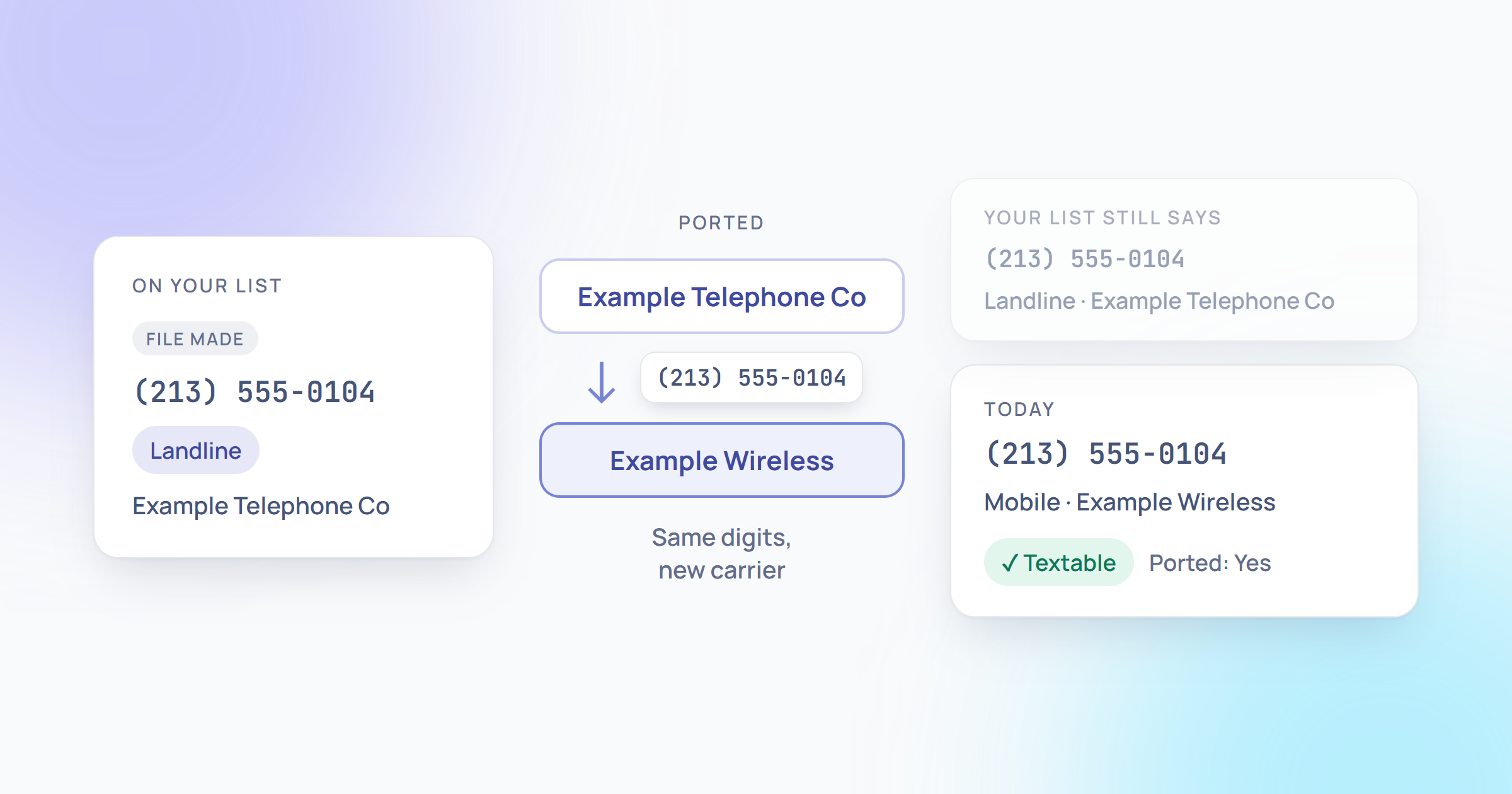
A ported number is the same digits on a different carrier
Porting is how people keep their number when they switch phone company. The new company asks for the number, the old one releases it, and calls and texts to the same ten digits start reaching the new carrier.
It works across kinds of service, too. A number can move from a landline company to a wireless carrier, from wireless back to landline, or to and from an internet phone (VoIP) provider. US rules call these intermodal ports, and they expect a simple one to be done within one business day.
So a number can change carrier, and change the kind of line it is, between the day your file was made and the day you send.
The carrier on your list is the one that held the number when the file was made
Phone numbers are handed to carriers in blocks: a whole exchange of 10,000 numbers, or a thousands-block of 1,000. NANPA's public reports record which carrier each block went to, and our area-code pages show them.
A port moves one number out of its block and leaves the record where it was. If your data provider filled in the carrier from records like these, or from a lookup it ran months ago, the column shows who held the number then.
Which carrier routes a number today is kept by the Number Portability Administration Center (NPAC), the US database of ported numbers. Only authorized companies may read it, so lookup tools, ours included, get the answer through a data supplier.
Same digits, new carrier, old column.
A port can turn a landline into a number you can text, or take one away
Five numbers from one skip-traced file. The numbers and the carrier names are made up for this example. Next to each: what the file said, what a check says today, and what that means for your send.
| Number | What the file said | What a check says now | What it means for you |
|---|---|---|---|
| (213) 555-0104 | Landline, Example Telephone Co | Mobile, Example Wireless, ported | Textable. The file hid a mobile |
| (213) 555-0129 | Mobile, Example Wireless | VoIP, Example Voice, ported | Callable, VoIP flagged. Texting it is unreliable |
| (213) 555-0143 | Mobile, Example Wireless | Mobile, Example Cellular, ported | Textable. Only the carrier changed |
| (213) 555-0168 | Landline, Example Telephone Co | Landline, Example Telephone Co, not ported | Callable. Nothing changed |
| (213) 555-0185 | Mobile, Example Wireless | Mobile, Example Wireless, no answer on ported | Textable. A blank isn't a no |
Three of the five ported, and a fourth won't say. Only two of them change what you do: the old landline goes to your texting tool, and the old mobile that became a VoIP line moves to the dialer.
Row three is the one to remember. It ported, the carrier name changed, and nothing about how you reach it did.
"Ported: yes" is not a reason to drop a number
It's tempting to read "ported" as a warning sign. It isn't one.
Ported says the number moved at some point. It doesn't say when, and it doesn't say the line got worse. Someone who switched mobile carriers for a cheaper plan shows up as ported, and their phone takes texts exactly as it did before.
What decides whether you can text a number is the line type it has today. That's how our verdicts work: textable, callable, invalid or unknown comes from the line type alone. The ported answer sits next to it for context and changes nothing.
Here are the same five numbers as they come back in all.csv, the download with every result column.
| Number | nl_line_type | nl_carrier | nl_ported | nl_verdict |
|---|---|---|---|---|
| (213) 555-0104 | mobile | Example Wireless | true | textable |
| (213) 555-0129 | voip | Example Voice | true | callable |
| (213) 555-0143 | mobile | Example Cellular | true | textable |
| (213) 555-0168 | fixed_line | Example Telephone Co | false | callable |
| (213) 555-0185 | mobile | Example Wireless | — | textable |
Read down the last two columns. The verdict follows the line type every time, whatever the ported column says.
Filter on line type. Keep the ported column for context.
What the ported answer can't tell you
- When it moved
- There's no date. A number that ported years ago and one that ported last month look the same, and we don't show a porting date.
- Whether a very recent move has happened
- Carrier answers are cached, so a number that moved very recently may still show its old carrier.
- What a blank means
- An empty ported answer means our data source didn't say. Treat it as unknown, never as a no, and go by the line type like any other number.
- Whether the number still belongs to the person on your list
- Ported describes the number's carrier. It knows nothing about who uses the number now.
- Whether you may contact them
- Ported isn't a Do Not Call or consent check, and neither is anything else we return.
Check one number free, or the whole list in one upload
Run the check close to the day you send.
Step 1
One number: use the free carrier lookup
Type the number in. You get the line type, the carrier, the region and whether it was ported, on one card. Free checks every day, with no account and no card.
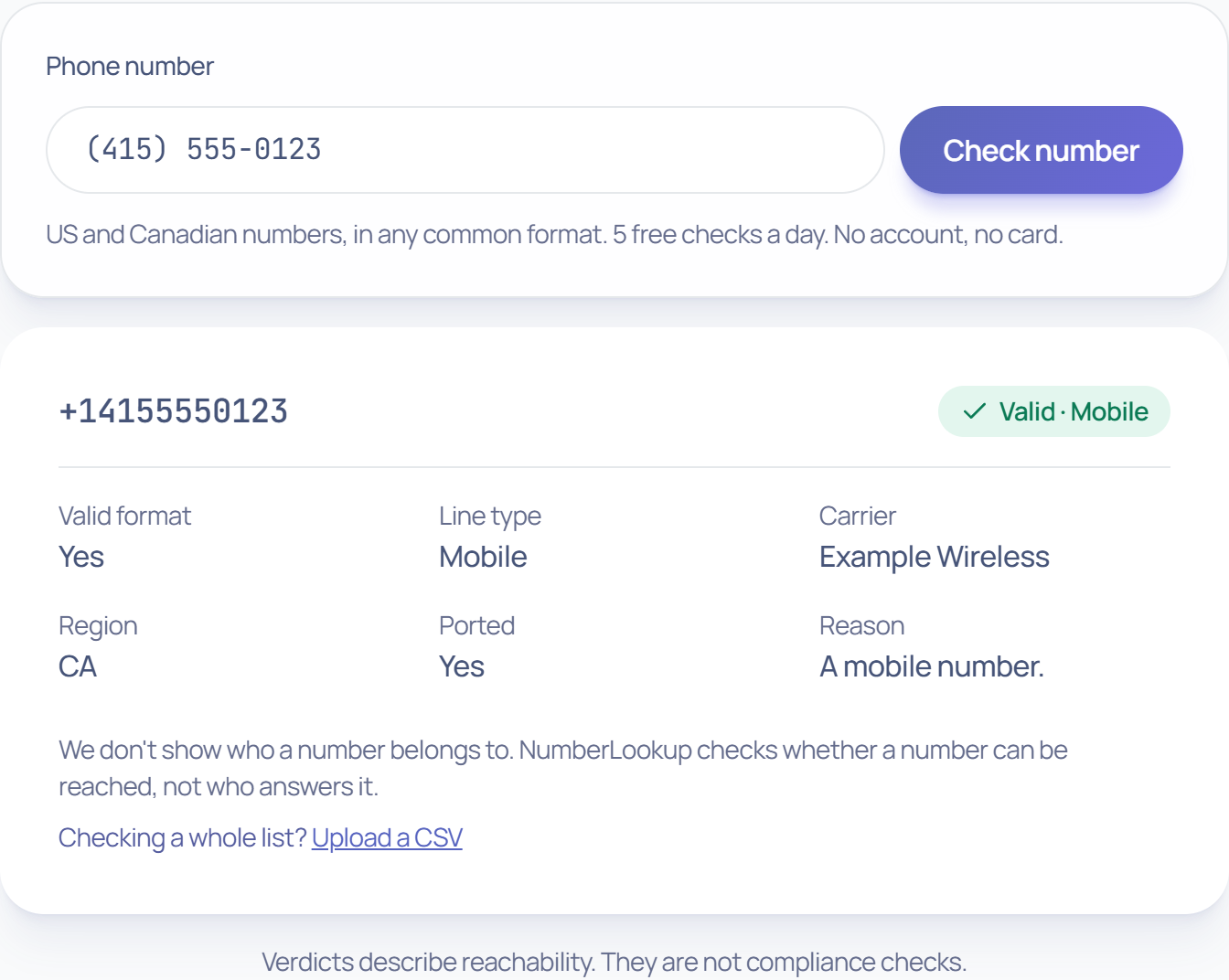
Ported: Yes, and still a mobile. The line type decides where it goes. Step 2
A list: upload the CSV and see the cost first
Keep the file the way your skip trace gave it, every phone in its own column. You see the credit count before anything runs. Repeats and blanks are free, and anything that comes back unknown is refunded when the list finishes.
Step 3
Send each file where it belongs
texting.csv goes into your texting tool, calling.csv into your dialer, and removed.csv holds owners with no working number. If you want the ported answer, it's in all.csv: one nl_ported column, or nl_phone1_ported, nl_phone2_ported and so on for a list with several phone columns.
A list goes stale, so check it again before you send
Ports don't stop the day your file is made. Switchboard, a texting platform, says in its help center that it looks a number up again "at least once every 90 days, to handle cases where it might have been ported to a different carrier or type." That's their schedule for their own data. For yours, the rule is simpler: the older the line-type column, the longer its numbers have had to move.
How many numbers on a typical skip-traced list have ported? We haven't measured it, so we won't guess.